

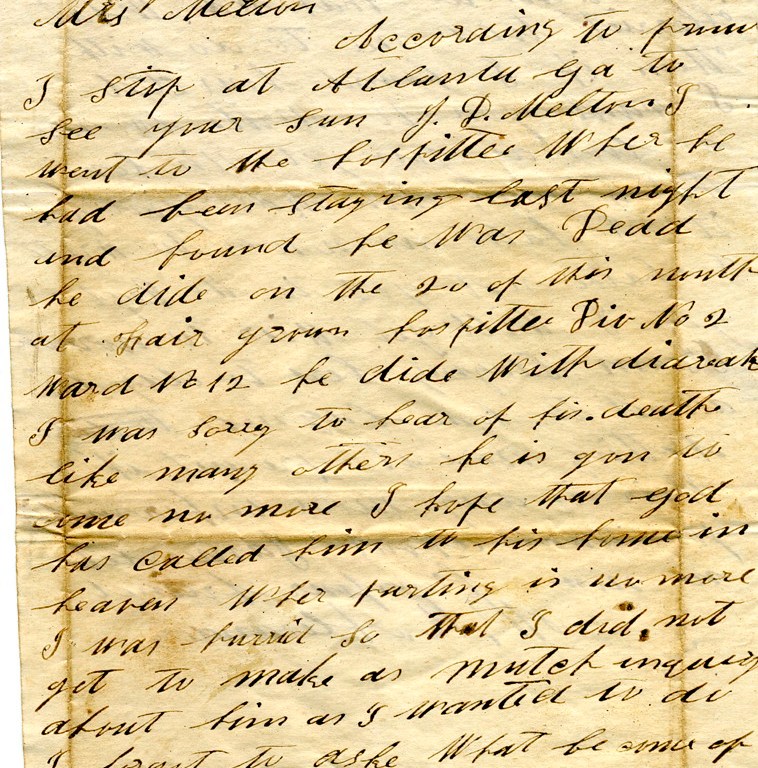
Recently I was given a collection of letters written by a surgeon in the Civil War to digitalize. The hundreds of letters were written on good paper, and usually marked by ink or more often pencil from the field. A few are smudged with dirt, or worn at the edges. They are tightly folded, and resist opening. They must be coaxed into laying flat, carefully, or they will rip and tear.
Reading over the letters, they are nearly all addressed “Dear Jennie,” or sometimes, “My Dear Bug.” William, the writer, carried on a long correspondence with Jennie. The letters begin seven years before the Civil War began, when William and Jennie were good friends. In the middle of the war they married. The letters continue, until 1870, when William died.
The letters contain observations on the war, on surgery and medicine, on rules and regulations, on sanitation and news from the front. But they also contain gossip, unflattering descriptions of colleagues, pointed critiques of co-workers and acquaintances, friends and family. And they also run sometimes for many pages on their feelings for each other, their misunderstandings, their sharp attacks and defenses of their ideas and feelings–the give and take of any personal relationship over a span of fifteen years.
I take the letters and carefully open then out, lay them on a plate of glass and push a button. A bright electric light shines momentarily on them, and then I refold them and lay them back in their crumbling envelopes. Scanned and digitalized, I have preserved the words and passions from one hundred and fifty years ago, saved them from crumbling into dust, even as the writers and the men and women they wrote about have long since turned to dust themselves.
But I wonder as I do this: What would William and Jennie have thought of having their private words exposed to electric light and then sent by internet around the world for anyone to read, decades into the future? Would they have approved? Would they have tried to edit the letters?
 Wist Blog: Creative Scribbles