

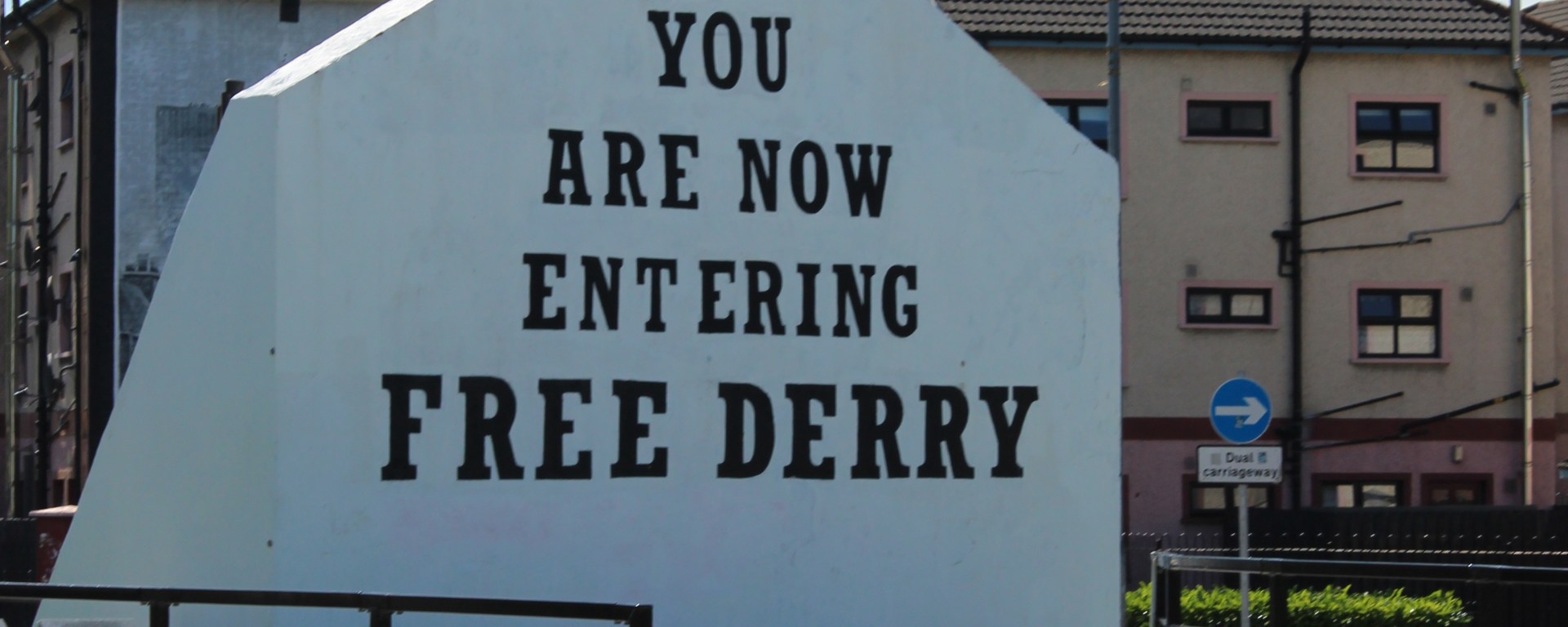
This morning I went down for breakfast. We were a couple of minutes early, so I saw an elderly woman by herself and said hello, and she started up a conversation. Everybody else went to breakfast, but we were talking away. After a few minutes, she asked where I was from. After telling her, I asked where she was from.
“Londonderry!” she said. The full name. No hesitation. A challenge really. She looked at me sternly. No Surrender.
* * *
Yesterday morning we had crossed out of the Republic of Ireland, and into Northern Ireland. Instantly, the signs were all in English only–no Gaelic. All along the way north we had seen signs giving the distance in kilometers to Derry. Now it was in miles, to Londonderry. On the second sign across the border, someone had spray-painted out the “London.”
Londonderry was originally called Derry, but when the English took over they built a wall around the city and called it Londonderry. In 1690 the Catholic English King James II laid siege to the town for over 100 days. He bombarded the town. The English Presbyterians in Londonderry closed the gates, shouted back each day, “No Surrender!” Finally the Protestant William of Orange relieved the city at the Battle of the Boyne. Catholic-Protestant relations had already been bad. Now they were worse, and would remain so for centuries to come. Catholics were not allowed to vote, own land, get an education. And each year Protestant Londonderry paraded through the town, celebrating the Protestant victory of William, right through the Catholic neighborhoods.
July 12 is celebrated in Northern Ireland much like the Fourth of July in the US. With parades, bonfires, vacations and holidays. Everything shuts down.
This morning, when I met this woman, was July 11. She was away from Londonderry here in Westport for holiday. “I’m Presbyterian,” she further announced. “Did you walk the wall in Londonderry?” she asked. “I go to First Presbyterian Church.” Built right up to the wall, religious ground zero for Northern Ireland Londonderry Presbyterianism. She announced it the same way she did “Londonderry”–as a challenge.
That morning we had taken a walking tour through the streets where the Bloody Sunday shootings had taken place in 1972. Our guide was Catholic. It was the beginning of “The Troubles,” which really lasted till just a few years ago, and there are still some instances going on. Men, women, children killed in the streets. Taken away to prison without charges. Dying there, on hunger strikes. There are painted murals in the streets of those times now, based on photographs. Some I remember seeing in the paper. As he talked about the way Catholics were treated, there were tears in my eyes.
It is changing now, largely because both sides can see the future, and it is moving to the Catholics. Things are much better, but much still needs to improve. The Londonderry City Council recently tried to change the name back to Derry. The British government refused.
* * *
“We have a lot of history,” the woman at breakfast tells me. She tells me about her sister dating an American in WWII, and marrying him and moving away. She married someone in the RAF, and they were stationed in Germany for three years after the war. She comes to Portrush every year for the July 12 holiday. But she is alone–her husband died sometime ago. She is proud of the fact that German u-boats surrendered in Londonderry at the end of the war. She is proud of the fact that Martin Luther King III and the Dali Lama were in her church a few weeks ago, to further the peace efforts. I finally slip away. As I am leaving, she says:
“I hope you don’t think we are a terrible people.”
And I wonder how a government can bring in outsiders, and refuse to leave or let the local population have any say in their own lives. And I know many Sioux, Pawnee, Cherokee who would say the same thing to me. And I wonder what it must be like to know your own rule is ending, and the peace will be difficult and a struggle. And you know that many in the world think you are terrible for it.
“No, I don’t think you’re terrible,” I say. And she smiles. And she looks out the window, sitting alone as I walk away.
 Wist Blog: Creative Scribbles